
Customer Survey Results:
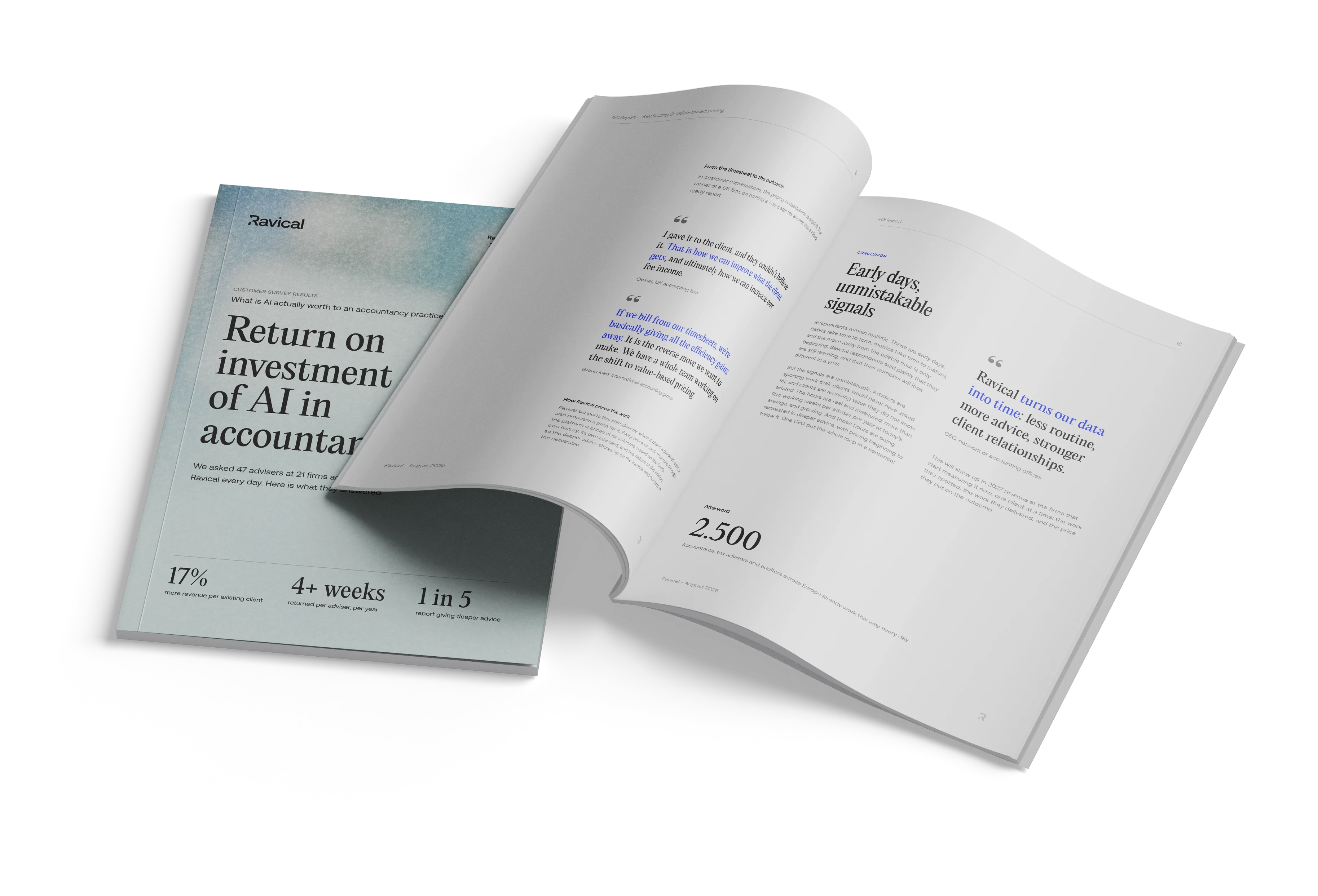
The Ravical ROI Report 2026
What is AI actually worth to an accountancy practice?
We asked 47 advisers at 21 accounting, tax and advisory firms across Europe who use Ravical every day.
Read their findings here: the revenue opportunities it spots, the hours it returns, and the pricing shift it starts.
Download
The Ravical ROI Survey Report
What AI is already delivering, measured
Accounting firms have run on the billable hour for as long as the profession has existed. AI is the first real challenge to that model, and the firms that adopted it early now have real numbers to build on. This report shows what those firms are already seeing today, and what others can reasonably expect.
Who did we interview?
In June 2026 we surveyed 47 advisers at 21 accounting, tax and advisory firms across Europe, from independent practices to full-service groups serving thousands of end clients. More than a quarter of survey results came in from partners or directors; the rest from the people in daily client work: accountants, tax advisers and client managers. Most have been using Ravical for only a few months, so these numbers are an early baseline.
47
Advisers surveyed
21
Firms represented
Key finding 1
New revenue opportunities are the primary value driver
Ravical works on top of the firm's existing systems and data: it reads across clients' emails, files and financials, and flags additional revenue opportunities a person would have to sit down and look for: a subsidy, a tax optimisation, an anomaly in the numbers.
Without being prompted, one in five respondents described work of a different level, not the same work done faster.
34%
Now discuss spotted work with clients through interactive reports and dashboards built on the client's own data
1 in 5
Spontaneously described deeper or broader advice, unprompted
— Partner, accounting network
Key finding 2
Efficiency gains are reported across the board
Every respondent reported time gains. The average is 3.7 hours per adviser per week, and the median sits at the same level, so the number is not propped up by a few outliers. Over a year, that is more than four working weeks per adviser.
Today's gains come almost entirely from single actions, an email, an analysis, a document. Most of these firms are only now rolling out workflows: chains of work that run across the whole client book in one pass. That's where the next jump lives.
3.7 hrs
Average weekly time returned per adviser
1 in 3
Recovers 5 to 8+ hours every week
4+ weeks
of working time returned per adviser per year
Almost half a working day, every week
Every respondent reported time gains: an average of 3.7 hours per adviser, per week, more than four working weeks a year. Here's where that time comes from today:
Client emails
94%
Knowledge questions
87%
Documents
68%
Interactive reports
34%
Own workflow
21%
Share of advisers using Ravical across each part of daily client work. Today's gains come almost entirely from single actions, before Workflows have even rolled out.
Key finding 3
The move to value-based pricing has started
When Ravical plans a piece of work, it also proposes a price for it, based on the firm's own history, its own rate card, and the nature of the advice. That's the mechanism behind the shift: deeper work shows up on the invoice, not just in the deliverable.
Asked how much time they save, a distinct group of respondents pushed back on the question. They're spending the same hours on the same client, but going deeper instead of moving faster, and an hourly invoice would charge exactly the same either way. Value-based pricing is what lets that extra depth show up on the bill.
17%
Revenue growth per existing client
Ravical lets me go deeper than I could before, spending the same amount of time. But the client gets far better advice, and that reflects in our fees.
— Partner, accounting network







In conclusion
Early days, unmistakable signals
These are early days: habits take time to form, metrics take time to mature, and the move away from the billable hour is only beginning. Several advisers said plainly that they're still learning, and that their own numbers will look different a year from now.
But the signal is already hard to miss, the hours are real and measured, and they're being reinvested in deeper advice, with pricing beginning to follow it.
Book a demo