

Foreword
From Gary Turner, Technology Investor:
"Over the past 50 years, technology has continually transformed how businesses operate, driving ever greater gains in productivity and value creation. From the personal computer and spreadsheets to the internet and cloud platforms, each wave of innovation has pushed accounting forward. Today, the profession stands at the foothills of what may be its most significant shift yet, as the world enters the era of artificial intelligence.
However, while all practitioners will be curious about AI, many understandably lack the certainty and knowledge to define their own strategy with confidence. This report was designed to address that need by uncovering attitudes and insights from fellow practitioners — both from firms already working hard to drive AI adoption, and those still beginning their journey from the sidelines."
Introduction
Artificial intelligence in accounting is no longer a future consideration — it's already reshaping how the profession works, day to day. New research from Ravical, based on a survey of 500 decision-makers within UK accounting firms employing 30 or more people, shows AI streamlining operations, changing client expectations, and redefining the value accounting firms can offer.
Yet for many firms, the pace of change is creating a real problem: the potential of accounting AI is clear, but the path forward isn't. Nearly two-thirds of clients (64%) now turn to tools like ChatGPT before they turn to their accountant, and 65% of firms recognise they have a responsibility to help clients adopt AI safely and effectively — yet 42% say they're struggling to meet rising client expectations, and 87% report having genuinely stretched resources.
Despite the uncertainty, the picture is growing clearer. In the future, the accountant's value will lie not in processing information, but in applying judgement, adding context, and building trust. This isn't just about removing mundane tasks — it's about delivering better-quality work for clients. In an always-on, always-connected environment, this report shows how AI accounting automation will unlock new levels of professionalism, enabling advisers to offer broader, more proactive, and more strategic advice.
Chapter 1
Clients are bringing AI to their accountants
AI's prominence in the accounting industry is increasing tenfold, but it isn't accounting firms driving that shift — it's clients. AI is already a popular discussion point between accountants and their clients: businesses are bringing pointed questions to the table, including "how are you using AI to add value?" (63%) and "could AI replace your services, or even accountants in general?" (51%).
This trend goes beyond words. Businesses are arriving with their own AI-generated outputs already in hand, with over half of firms (54%) reporting they occasionally have to review or correct ChatGPT-generated advice their clients have received, while 20% frequently have to correct it — some of it misleading or simply incorrect. This isn't isolated behaviour: nearly half of firms (45%) report that a significant share (26–50%) of their clients are already using AI in some way for tasks accountants have traditionally handled.
The most common current uses of AI within client businesses are:
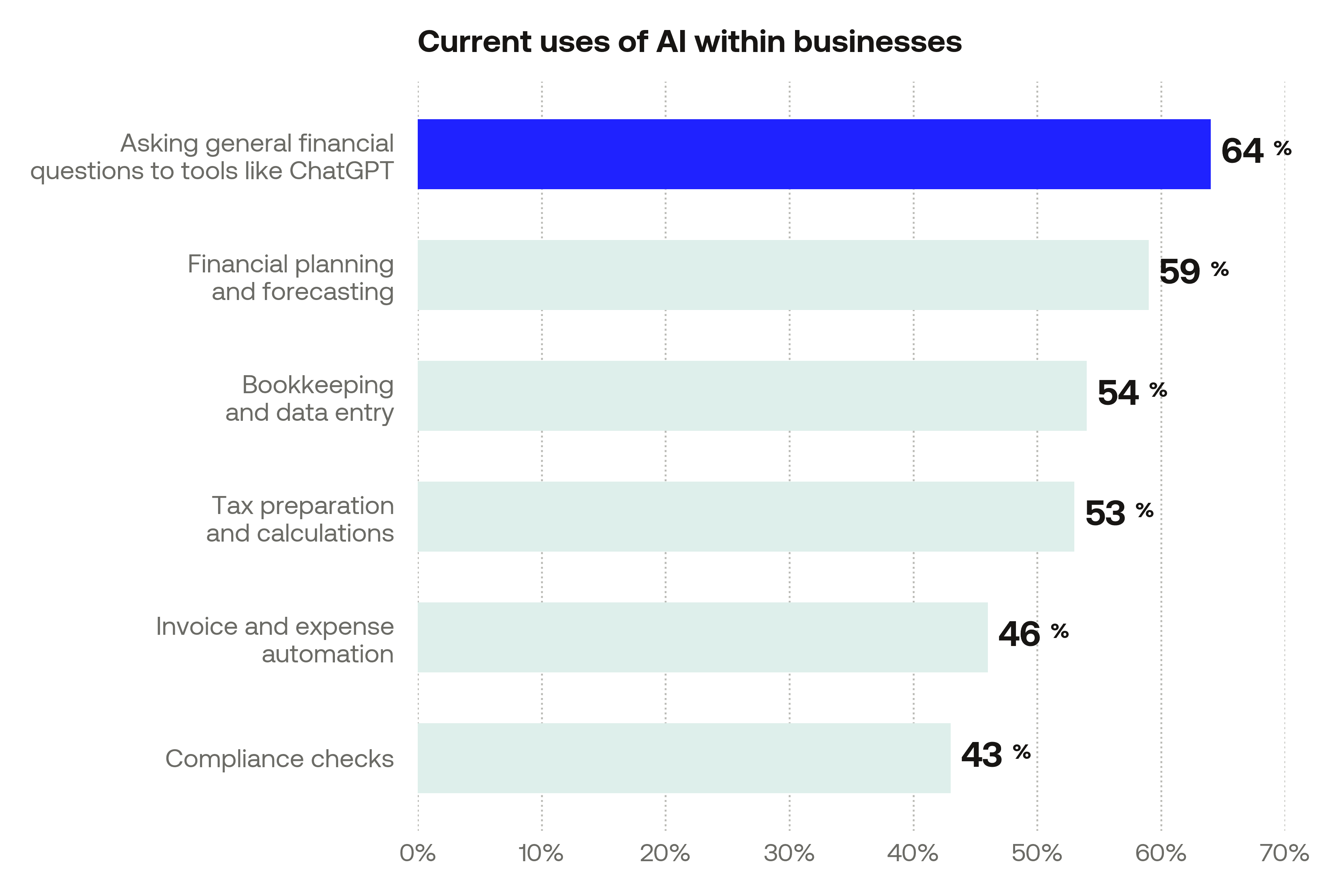
Perhaps more critically, four in 10 businesses (39%) are using AI to challenge or validate advice from their accountant. This has forced firms to reposition themselves — not as gatekeepers of knowledge, but as interpreters, advisers, and enablers of the AI their clients are already using.
As Joris Van Der Gucht, Co-founder and CEO of Ravical, puts it: "Businesses are bringing AI to their accountants, not the other way round. That introduces risks when advice is wrong or misleading — but it also presents a huge opportunity for the profession."
Chapter 2
The impact on accountants
The accountancy profession is on the brink of a skills overhaul. Nearly half of firms (46%) believe there will be a significant shift in accountants' skills, where many current capabilities become less relevant. Almost a quarter (23%) foresee a complete transformation, where new expertise will be required just to keep pace, let alone lead.
Technical expertise in tax or audit is no longer seen as the sole marker of value. Instead, accountants themselves rank fluency with AI accounting software and data analysis at the top of the future skillset, backed by human attributes like critical thinking and client communication. The top skills firms expect to grow in importance:

Firms feel largely ready for this shift, with almost all (96%) saying they're prepared, and half (49%) saying they're very well prepared. Despite that confidence, firms report real challenges in developing these skills internally — and the real stumbling block isn't competence, but culture. According to a fifth of accountants (21%), internal resistance to change is the single biggest barrier to upskilling, ahead of a lack of internal expertise or a lack of time and capacity.
Many accounting firms are already taking steps to maintain their value proposition as clients ramp up their own AI use: seven in 10 (70%) are exploring how AI can enhance their own services, and 68% have already made investments in accounting AI tools for internal use. The profession is learning to share the driver's seat with AI, on the understanding that the firm's own advisory judgement must still shape where that AI-supported work ends up.
Chapter 3
AI and the role of the advisor
The best advisers see their future not in competing with AI, but in helping clients adopt it safely, interpreting its outputs in context, and designing the systems around it. Firms recognise the responsibility they have to their clients here — over half (59%) have already started helping clients understand and safely use AI.
It's little surprise that meeting rising client demand sits at the top of accounting firms' biggest challenges today: meeting rising client expectations (42%), keeping up with new technologies (38%), and explaining complex data simply (37%).

In the last 12 months, firms have watched their clients become more interested in using AI or different tools (61%), want personalised and strategic advice (54%), seek more proactive insights (49%), and demand support beyond their financials — including technology adoption, ESG, and wider business strategy (45%). Some of these expectations mark a significant departure from the accountant's traditional role, but firms have heard their clients clearly: nearly half (49%) are already in the process of repositioning their service offering to reflect these expectations.
The industry's commitment to its clients is never in question, but there's a general consensus among 97% of firms that AI will impact the way the profession works, to varying degrees:
35% believe AI will be transformational — redefining how accounting firms work, deepening client relationships, and creating new professional growth paths
49% believe AI will bring significant impact — major gains in service quality and career development within current ways of working
13% believe AI will bring moderate impact — improvements across processes, but with little change to core work or growth
On the question of how to use these tools responsibly, the answer isn't blind trust — it's a measured approach that combines the speed of AI accounting automation with the irreplaceable value of human oversight. Over half of respondents (55%) report they trust AI tools but require human oversight, a quarter (25%) say they trust AI tools fully for relevant tasks, and 16% are cautious but open to experimenting.
That growing trust is backed by financial investment: nearly half of firms (48%) have planned investments in AI of £50k to £100k over the next year. Success will be judged less by internal efficiencies than by what clients experience, with improved quality of customer service coming out on top (55%) — ahead of greater scalability, faster turnaround, stronger client retention, and reduced risk.
Chapter 4
A profession in transition
As future success for accounting firms is heavily driven by clients, it's only natural for firms to remain in a perpetual state of evolution. This inevitably brings a heavy workload, which for accountants is nothing new — but the source of that pressure is shifting. Even as clients demand more personalised, strategic, and proactive advice, routine admin tasks currently take up more resource than client communication and advisory work itself. The current ranking of accountants' most time-consuming tasks: accounts preparation and statutory filings, payroll processing and related compliance, audit and assurance work, routine administrative tasks, bookkeeping and transaction processing, advisory work and reporting, client communication and chasing information, business development and client onboarding, internal review and quality control, and staff oversight, training and professional development.
Coupled with shifting client demands, the pressure only intensifies. Nearly nine in 10 (87%) accountants say they feel stretched, citing meeting client expectations (42%), keeping up with new tools (38%), and explaining complex data simply (37%) as the frontline challenges. Firms want to reposition themselves as advisers, but routine work and the "pull of the inbox" keep dragging them back.
What's important to recognise is that, despite the appetite to implement AI wherever possible, businesses will continue to turn to their accountants for guidance — 59% of firms report their client base has actively sought advice on how to effectively use AI tools. AI will reshape the role of accountants, of that there's little doubt — but this technology is not on a trajectory of replacing them.
Accounting firms are taking action. Nearly four in 10 (38%) have started taking steps to shift their focus to high-value advisory work, including the deployment of AI accounting software across their service portfolio. Most firms (31%) are at the rollout stage, a fifth (21%) are now trialling or piloting tools in specific areas, and only 15% are still in the early exploration phase. Nearly three in 10 (29%) already have AI integrated into their day-to-day ways of working.
As Joris Van Der Gucht, Co-founder and CEO of Ravical, puts it: "AI will not replace accountants, but it will change the way they work. We are entering a post-knowledge economy, where knowledge alone is no longer a differentiator. The future of the profession lies in AI-powered collaboration between advisors and their clients."
Conlusion
Welcoming the modern business advisor
The accounting profession is in the midst of a fundamental transition, as it moves away from a solely reactive financial advisory role and welcomes in the modern business advisor.
The reactive financial advisor was centred on routine, repetitive tasks (bookkeeping, statutory filings, payroll processing); acted as gatekeeper of knowledge and the sole source of financial information; was reactive rather than proactive, typically responding to client needs on an as-needed basis; was valued for deep technical understanding rather than broader business strategy; had minimal client interaction limited by transactional relationships; and relied on traditional tools with little to no integration of AI or automation.
The modern business advisor, by contrast, is defined by a different set of capabilities: working with clients to adopt AI in a safe and effective way (65%), interpreting data and AI outputs in context (64%), designing and overseeing the right AI systems and processes (57%), building strong personal client relationships (56%), bringing judgement and experience to complex decisions (51%), and acting as a sounding board and trusted voice for clients (44%).
This is exactly the shift Ravical was built for. Knowledge alone is no longer the differentiator, and the real value lies in how accountants work with AI to apply judgement, context, and social skills for their clients. Firms shouldn't have to choose between speed and quality, or between AI and expertise — AI is there to augment service delivery, while experts' judgement sets the standard, so firms can justify investment through improved client experience and sustained trust.
As Joris Van Der Gucht, Co-founder and CEO of Ravical, puts it: "Accountants are ready for AI, but unsure how to remain in control. Ravical provides the bridge, equipping expert firms to thrive by reshaping how their expertise is applied."

About Ravical
Ravical is an AI company helping expert firms adapt and thrive in the post-knowledge economy. Founded in 2025 and headquartered in Ghent, Belgium, Ravical is led by CEO Joris Van Der Gucht, co-founder of the accounting automation platform Silverfin, alongside co-founders Ken Bastiaensen and Benjamin Vandermarliere, PhD.
As large language models and agentic AI systems transform how knowledge is accessed and applied, Ravical provides the accounting AI automation professionals need to stay relevant, remain in control, and keep improving. Its platform equips firms with AI agents that work to expert standards, connect seamlessly to existing systems, and operate under human oversight — with transparent governance, real-time context, and collaborative client spaces that let experts move from reactive service delivery to proactive, AI-powered collaboration.
In May 2025, Ravical secured €7.3 million in pre-seed funding led by Lakestar, with participation from Pitchdrive, Entourage, and strategic angel investors. This investment underpins the company's mission to equip professional services firms — including those in accounting, tax, legal, HR, and insurance — with domain-trained AI agents that can automate up to 80% of routine workflows, freeing experts to focus on the high-value, strategic work that deepens client relationships. Ravical is already piloting its accounting workflow software with professional firms across Europe and beyond.
Ravical doesn't believe AI replaces expertise — rather, it redefines it. By augmenting professionals with intelligent, controllable AI, Ravical ensures that the value of expert firms lies not only in what they know, but in how they apply their judgement, skills, and client relationships in a new era of work.
A survey of 500 UK accounting firms reveals how AI is changing client expectations, accountant skills, and the future of the profession.