

Half of UK accounting firms say the biggest barrier to advisory growth isn't time. It's that their teams are built for compliance, not advisory. New research from 500 senior decision-makers reveals why freeing up capacity won't fix a skills problem.
Introduction
Every accounting firm has heard the same story by now: automation and AI will strip the manual work out of compliance, free up hours in the team's week, and that freed time will naturally flow into advisory services. It's a tidy narrative — and according to new research from Ravical, it's wrong.
Ravical surveyed 500 senior decision-makers at UK accounting firms with more than 50 employees — all of them responsible for evaluating or purchasing software at their firm — to understand what is actually standing between accounting firms and advisory growth. The findings, collected in February 2026, tell a different story than the one the industry has been repeating: the bottleneck isn't a lack of hours. It's a skills and infrastructure gap that more free time won't close on its own.
Half of firms say the single biggest barrier to converting spare capacity into advisory revenue is a skills mismatch, not a time problem. Their teams are good at compliance. They are not equipped to spot advisory opportunities, or to sell into them once they've spotted them.
Two definitions are worth having upfront, since the report leans on them throughout:
Compliance services
Legally required, process-driven work that keeps clients on the right side of statutory and regulatory obligations: annual accounts, corporate tax returns, VAT filings, payroll, personal tax returns.
Advisory services
Everyday advisory (practical guidance on day-to-day decisions like tax planning, cash flow, pricing, forecasting, usually triggered by client questions) and specialist advisory (project-based expert advice on events like succession planning, M&A, restructuring, fundraising).
Here's what the data says about the gap between those two, and what firms can do about it.
Chapter 1
More time will not fix a skills problem
The industry's prevailing logic goes: compliance work is becoming more automated, that automation frees up capacity, and that capacity naturally shifts toward advisory work. It sounds reasonable. The data doesn't support it.
When Ravical asked firms what they would actually do if technology freed up 20% more capacity across their teams, only 6% said they'd convert that time directly into advisory revenue. Everyone else pointed to obstacles that have nothing to do with time itself:
25% said their teams are good at compliance but not at spotting advisory opportunities
25% said their teams are good at compliance but not at selling advisory services
6% cited a lack of supporting technology to identify and manage opportunities
11% said they wouldn't have the preparation and research done to act quickly
10% still wouldn't know which clients need advisory services right now
8% have no systematic process for turning opportunities into engagements
Add the two skills-based answers together and they account for half of all responses — double the number of firms citing a lack of technology. This isn't about confidence or motivation. Compliance skills are technical and process-driven; advisory skills are relational, contextual and commercial. Firms have spent years hiring, training and measuring performance around the first set. The second is largely absent from how they build their teams.
A related and more uncomfortable finding: 94% of firms would not convert freed capacity into advisory revenue, even with 20% more time — despite 62% actively pursuing advisory expansion as a strategy. Instead, they said they'd use the time to clear compliance backlogs (28%), reduce working hours (26%), or reduce headcount (17%). That last figure is worth sitting with: 17% of firms would treat AI-freed time purely as a cost-cutting lever rather than a growth opportunity.
Deploying generic AI tools into a firm where the real constraint is human skill tends to create more outputs to review and more drafts to manage — without removing the underlying bottleneck. The problem was never a lack of hours. It's the absence of the skills and systems needed to use those hours differently.

Chapter 2
The skills mismatch is structural, not incidental
Compliance and advisory aren't just two service lines — they're two different disciplines. Compliance is predictable, rule-based and measurable. Advisory is contextual, relational, and requires judgement under uncertainty: spotting that a client's upcoming refinancing opens a tax optimisation window, knowing how to raise succession planning, recognising that a string of small client questions signals a bigger strategic need. None of that follows automatically from technical accounting proficiency.
Nearly all firms — 89% — agree with this distinction: compliance scales through automation, while advisory depends on individual expertise and judgement. That's near-universal agreement on something the industry has spent years trying to paper over. It matters because the tools firms have built to scale compliance — standardised workflows, automated processes, purpose-built software — can't simply be redirected toward advisory. Advisory needs its own infrastructure, and most firms don't have it yet.
When asked to name the biggest challenges preventing advisory growth at the pace they'd like, firms pointed to a tight cluster of obstacles, with the people problem sitting at the centre:
Lack of time/capacity in the existing team — 38%
Lack of supporting technology and infrastructure — 34%
Lack of the right people (compliance skills ≠ advisory skills) — 32%
Advisory gets deprioritised by compliance deadlines — 29%
Difficulty retaining or hiring people — 29%
No clear way to systematically identify opportunities — 29%
Three of the top six barriers are directly people-related. The capacity constraint is real, too, but it isn't about energy or willingness — it's the preparation burden sitting upstream of every client conversation. Advisers currently serve around 50 clients in a meaningful advisory capacity; if that preparation and research were handled automatically, firms estimate they could serve 68 clients — a 35% increase in capacity without adding a single headcount.
There's also a striking disconnect between what firms believe about their own visibility and what the data shows. 96% of firms say they're confident they see all advisory opportunities across their client base — yet a third (33%) of clients' advisory spend goes to other providers. A quarter of firms don't know which clients have advisory needs right now, 29% have no systems to surface advisory signals from client interactions, and 37% say advisory delivery is entirely or mostly driven by individual advisers with no dedicated systems behind them. These are not fringe cases — they're the mainstream. Firms can't sell what they can't see, and the firms most confident in their own visibility may be the most exposed: when the real bottleneck is conversion rather than awareness, overconfidence is the last thing the data should support.

Chapter 3
The strategy is ahead of the capability
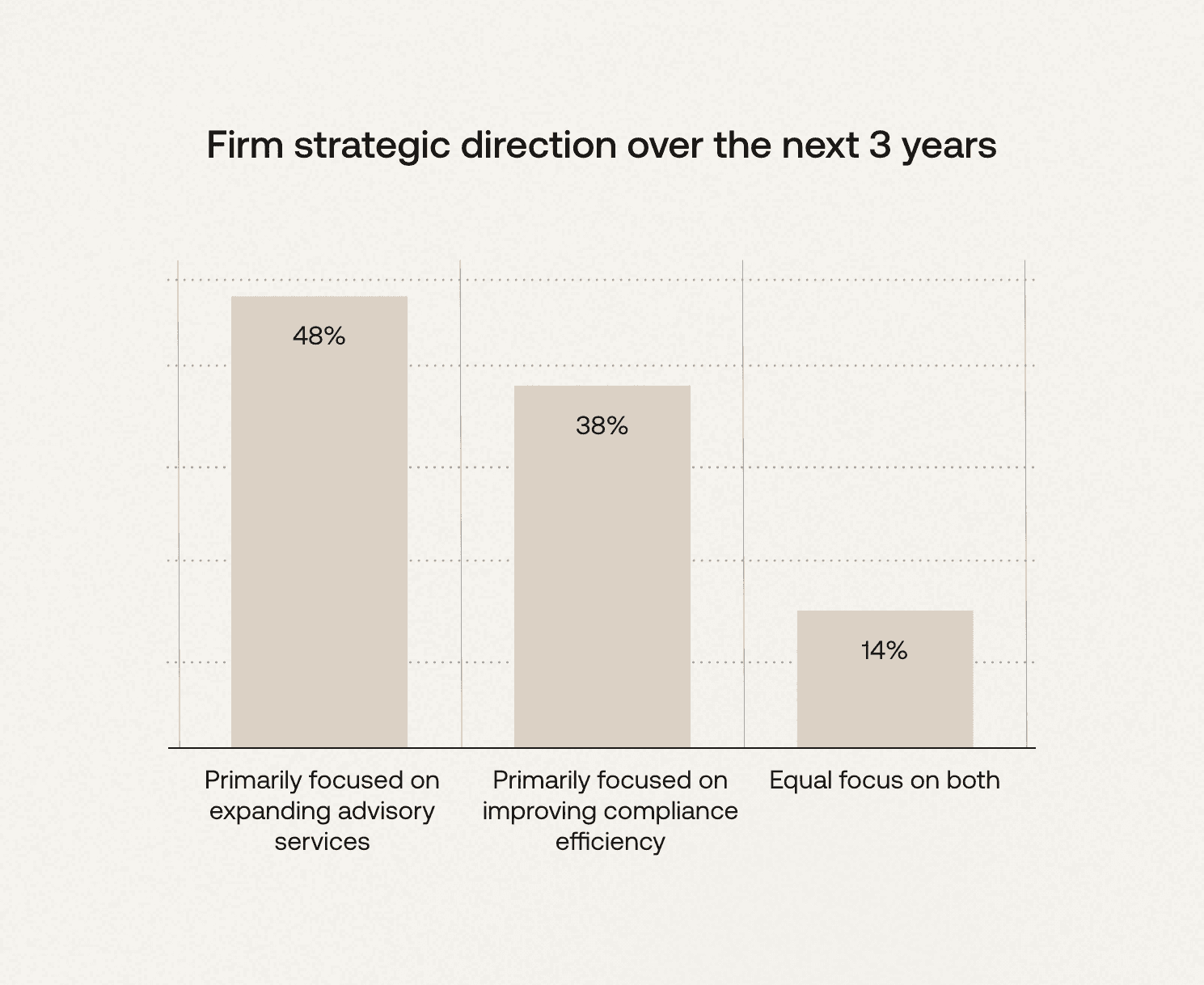
The industry has reached strong consensus on where it wants to go. 48% of firms say they're primarily focused on expanding advisory services over the next three years, and a further 14% are giving equal strategic weight to advisory and compliance. But there's a gap between declared strategy and operational reality that the data makes visible: 38% of firms remain primarily focused on compliance efficiency — nearly as many as those pursuing advisory expansion, and in tension with the 89% who say future margin growth will come from advisory. At some point, strategy and investment need to line up.
Time use tells a more nuanced story than "compliance still dominates everything." Asked how they actually split their time last month between compliance and advisory:
46% split their time roughly equally between the two
39% spent most of their time on compliance (61–80%) with meaningful advisory work alongside it
7% spent more than 60% of their time on advisory work
These are not compliance specialists who've never touched advisory — they're already spending real time on it. And they still cite a skills gap, a preparation burden, and a lack of systematic process as the primary obstacles to growing advisory revenue further. The issue isn't an absence of advisory activity. It's an absence of the infrastructure that would make that activity consistent, scalable and commercially effective.
Asked to name the single biggest constraint on faster revenue-per-client growth, firms pointed to a blend of time and systems, with a people-and-process problem underneath both:
Compliance deadlines crowd out advisory development — 25%
Advisory preparation and scoping takes too long — 22%
Client budget limitations — 18%
Lack of infrastructure to scale advisory delivery — 15%
Can't systematically identify which clients need advisory — 9%
Don't have the capacity to deliver more advisory work — 8%
The top two answers alone account for 47% of responses, and both are solvable with the right infrastructure. Firms have simply built their operational stack for compliance — advisory sits outside it, relying on individual effort and judgement rather than systems.
Chapter 4
The role of AI, and why belief is not enough
Firms have reached near-total agreement on AI's potential: 95% agree that AI and automation can help scale advisory services, with 0% disagreeing. That level of consensus is unusual in any industry survey, and it marks a genuine shift — the question has moved from "should we adopt AI?" to "how do we make it work for advisory?"
But belief and infrastructure are not the same thing, and that gap is exactly where advisory revenue is currently being lost. Most firms experimenting with general-purpose AI tools report that it adds more outputs to review and more drafts to manage, without removing the underlying bottleneck. When AI is deployed into an environment where the real constraint is a skills and process gap, it tends to amplify the noise rather than solve the problem. Less than a third of firms (29%) say they would actually direct AI-freed capacity toward advisory services.
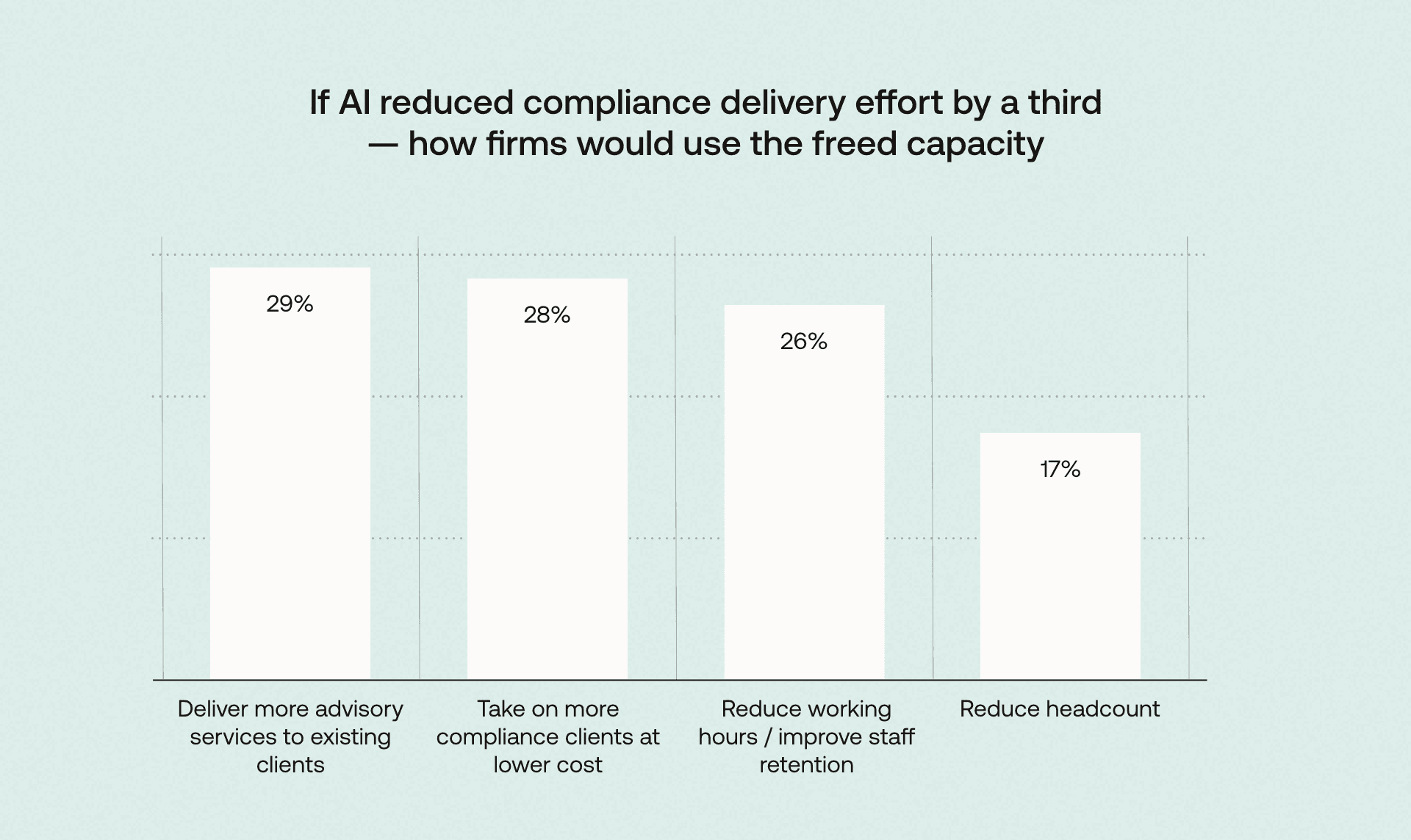
Asked how they would use freed capacity if AI reduced compliance delivery effort by a third, firms said:
Deliver more advisory services to existing clients — 29%
Take on more compliance clients at a lower cost — 28%
Reduce working hours / improve staff retention — 26%
Reduce headcount — 17%
That headcount figure deserves attention. For 17% of firms, AI is positioned as a cost tool rather than a growth tool. That's a legitimate business choice, but it isn't the same as expanding advisory capability — and it means the gap between compliance-only firms and advisory-ready firms is likely to widen rather than close.
The technology exists. So does the intent. What's still missing is the layer that connects them: the infrastructure that turns AI's potential into a systematic, repeatable process for identifying advisory opportunities, preparing engagements, and routing them to the right person at the right moment.
Conlusion
The gap can be identified and closed
The skills mismatch uncovered in this research isn't a leadership failure, and it isn't a talent problem in the usual sense. It's the predictable result of building an entire industry around one discipline — compliance — and then expecting the same professionals to operate effectively in a second, structurally different discipline, without changing much about the systems around them.
Compliance scales through automation. Advisory depends on individual expertise. Nine in ten firms (89%) already recognise this distinction — the operational implication, that scaling advisory requires a different kind of infrastructure than scaling compliance, follows naturally from it. Fewer firms appear to have acted on it yet.
The broader picture isn't as alarming as it might seem. Firms have healthy compliance margins, growing revenue per client, and 91% expect further per-client growth over the next three years. What the data raises isn't a question of survival — it's a question of composition. A meaningful share of today's growth is coming from compliance fee increases the industry expects to slow, and from client mix shifts that are one-off by nature. Advisory is the growth driver that doesn't come with an obvious expiry date.
Whether firms that build advisory infrastructure earlier will hold a durable advantage over those that move later is hard to say with certainty. What the data does suggest is that building this capability now, while compliance margins are still healthy, is a far more comfortable position than building it under pressure later.
To the extent this data captures it accurately, the people problem in accounting looks more tractable than a pure hiring or retraining challenge. The real constraint sits upstream of the adviser — in the systems that surface opportunities, prepare the groundwork, and make advisory work consistent enough to scale. That, at least, is a solvable kind of problem.
About Ravical
Ravical is an agentic AI platform — AI accounting software built for firms that deliver compliance and advisory services. The industry is moving toward advisory as its primary growth engine, but most accounting firms are still running on infrastructure built for compliance — and that gap creates real pressure on the people doing the work.
Ravical's accounting workflow automation embeds AI agents directly into existing firm systems, monitoring client communications and financial data to surface advisory opportunities and prepare the groundwork before an adviser needs to act. Partners and managers stay in control throughout, with full visibility into what the agents are doing and why.
The result: advisory work moves faster, more opportunities get captured, and the work that requires human judgement gets the time and attention it deserves.
Half of UK accounting firms say the biggest barrier to advisory growth isn't time. It's that their teams are built for compliance, not advisory. New research from 500 senior decision-makers reveals why freeing up capacity won't fix a skills problem.