

Introduction
UK accountancy practices could unlock six-figure revenue growth without winning a single new client. All it takes is a different approach to servicing the clients they already have.
New research from Ravical, based on a survey of 500 UK businesses currently working with an accountancy practice, shows that UK businesses want additional services many practices are not currently providing them — and a substantial share of that work is already being carried out by another firm instead. Almost all (92%) of surveyed respondents said they'd pay more for these services, and nearly half (47%) would pay between 11% and 25% more.
When asked why they use a different provider, the most cited reasons were that their firm never offered or recommended the service (35%) and that their firm only handles compliance for them (35%). Cost was the least cited reason, at just 27%. This isn't a client base looking for something cheaper. It's a client base whose accountant hasn't started the conversation about what else is available.
This pattern varies by firm size, but the takeaway is consistent across the market: nearly four in ten businesses (38%) say they would take up additional services from their accountancy practice if it could simply match the speed and responsiveness of other providers. The firms that move first will win back the relationships — and the revenue — that's currently sitting with someone else.
Chapter 1
Businesses want more from their accountants
Businesses aren't asking for a complete overhaul of services from their accountancy practice — from the market's perspective, there's no need for new capabilities, or new clients for that matter. There's a missed opportunity across services that are already on offer, but not well communicated to clients.
When businesses who don't currently receive a given service are asked whether their accountancy practice offers it, the most common answer isn't a categorical "no." It's closer to "I don't think so" — most businesses assume their practice offers the service, but it's never been confirmed. Looking at a typical practice's service portfolio, for every service tested, fewer than half of clients who don't receive it are confident their firm doesn't offer it:
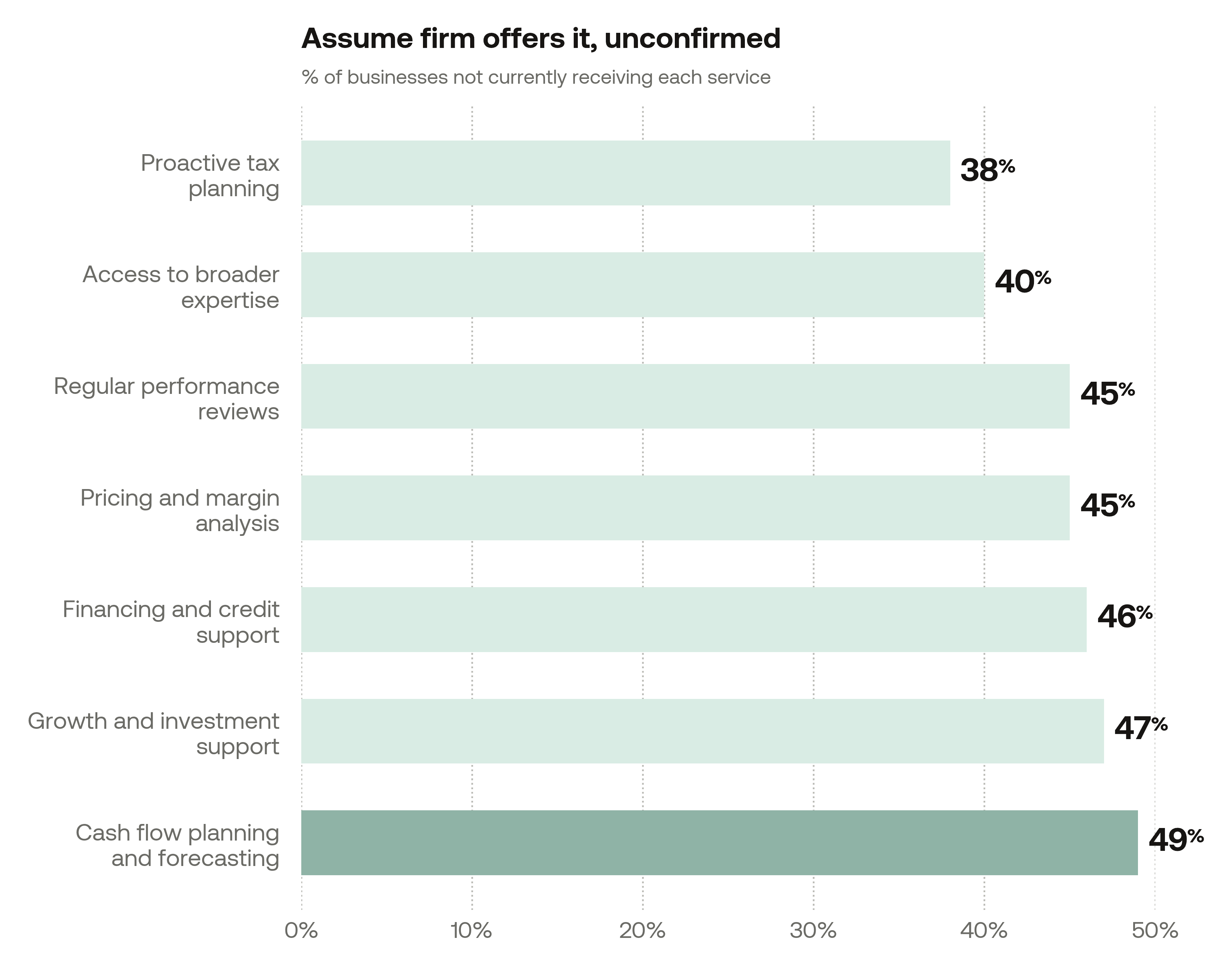
The absence of a service isn't, in most cases, a sign that the firm doesn't offer it. It's a sign the firm hasn't made it visible — which means it doesn't get bought. Across the same set of services, fewer than half of companies currently receive each one from their existing accountancy practice, and demand from those not receiving it runs at roughly the same level as the proportion already served. In practice, that means the addressable market for each service is approximately double what firms are currently capturing.
Chapter 2
What the additional revenue is worth
There's clear demand from businesses for greater access to the full range of accounting services. The question is whether firms recognise just how much that opportunity is actually worth.
The average annual spend on accounting services across UK businesses is approximately £19,700. Most clients sit in the £10,001–£25,000 band (45%), making this the primary segment for incremental revenue, followed by £25,001–£50,000 (26%) and £5,001–£10,000 (25%).
Businesses have more to spend, and 92% are willing to spend it if it means getting the services they need from their accountant — only 8% would not pay more under any circumstances. The average increase in spend across all respondents is 16% on top of current annual investment, and nearly half (47%) sit within the 11–25% band. Firms don't need to worry about price sensitivity holding this back: most clients aren't looking for a modest increase.
Pricing models are shifting, too. Fixed annual fees (23%) and fixed fee plus hourly top-up (20%) are currently the most common billing structures, with hourly-only billing accounting for just 11%. But client preferences tell a different story: outcome or value-based pricing is preferred by 19% of businesses — nearly matching the 23% who prefer fixed annual fees — while the billable hour model is the least preferred option overall, chosen by fewer than one in five businesses as their ideal. For accountancy practices that have been cautious about introducing value-based pricing, the data suggests the market is more ready for it than assumed.

Chapter 3
Where the money is going instead
If businesses want these services and their accountancy practice already offers them, where is the work actually going? Among companies currently receiving each service, a substantial portion isn't getting it from their existing accountancy practice. Across every service tested, more than a third of those who receive it are getting it from a different provider:
Service
From own firm
From different provider
Cash flow planning and forecasting
52%
34%
Regular performance reviews
42%
38%
Proactive tax planning
44%
38%
Growth and investment support
41%
38%
Pricing and margin analysis
41%
38%
Firm size shapes this pattern meaningfully. Clients of sole practitioners are the most likely to go elsewhere (42%). Clients of small firms (2–10 people) show the highest use of a different provider for advisory work (48%) and the lowest willingness to pay more (mean 9%), on the lowest current spend (£12,559). Clients of Top 50 firms show the opposite pattern: only 12% use a different provider, 64% source advisory from their own firm, and they show the lowest switching consideration of any segment (67%, versus 92–95% elsewhere). Clients of mid-sized and larger firms (11–250 people) sit in between — around 40% source advisory elsewhere, but they have the highest current spend (£24,298 for larger firms) and the highest willingness to pay more (mean 22%).
That middle segment is where the consolidation opportunity is sharpest. Mid-market firms already have the capability to serve these clients but haven't yet built the communication and activation structures to capture the work — a real opening to professionalise the relationship and compete with the Top 50 firms, if approached correctly.
Price isn't the primary driver behind this leakage. The top two reasons businesses gave for using a different provider — cited by more than a third of respondents — were that their firm never offered or recommended the service (35%) and that their firm only handles compliance for them (35%). A third of businesses favoured speed and responsiveness (33%); compliance is a structured, formulaic service, but what clients increasingly want is proactivity and genuine consultation beyond the traditional relationship. Right now, the revenue is going to whichever provider moves faster — not necessarily the one that's more capable.
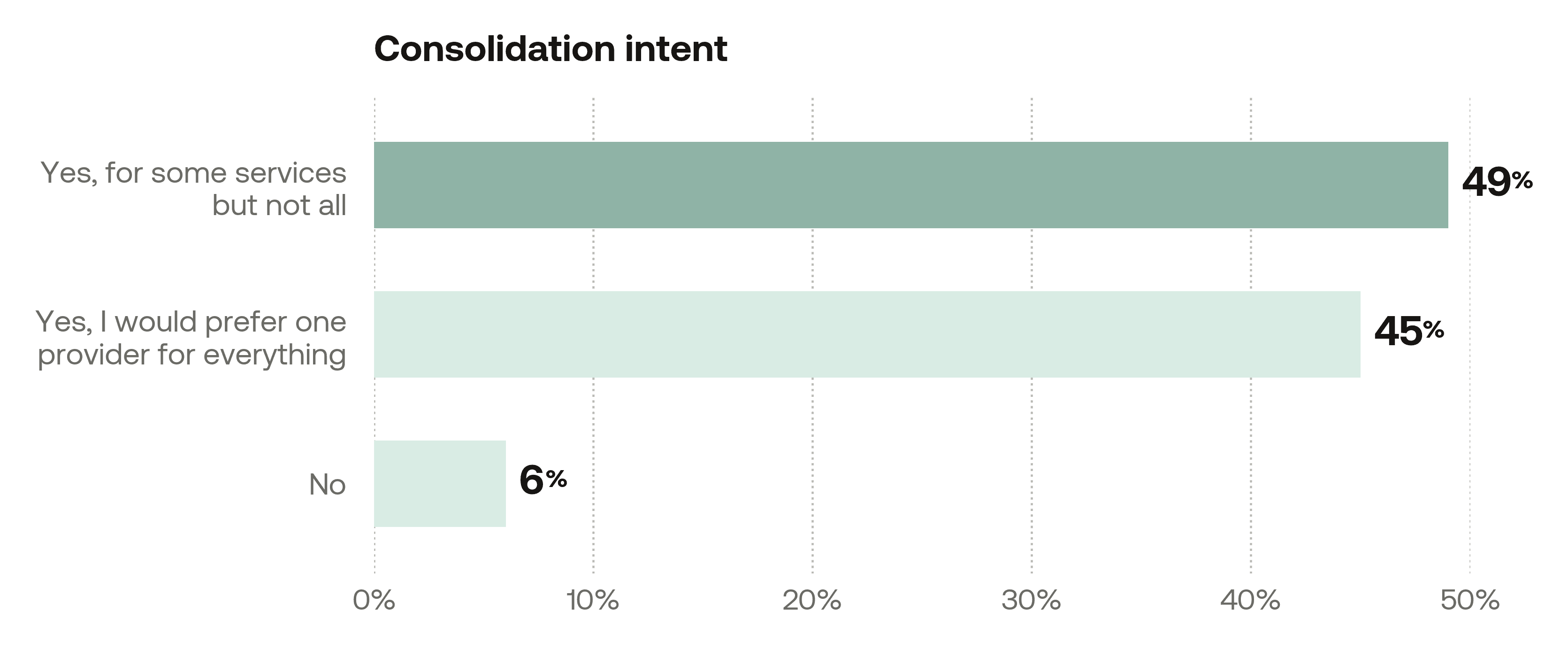
The good news: among businesses currently sourcing services from other providers, 94% say they would consider consolidating those services back with their accountancy practice if it could deliver to the same standard — 49% for some services, 45% for everything. Only 6% say no. That 94% represents an untapped revenue stream that's currently being lost to competitors who were simply faster to start the conversation.
Chapter 4
What it takes to activate it
Understanding what businesses want, and what they'd pay, is only half the picture. The other half is understanding what would actually make them buy it from their own accountancy practice specifically, rather than assume it isn't on offer.
While speed and responsiveness tops the list (38%), there's a fairly even spread across several factors: showing exactly what a client would get and what it would cost, upfront (37%); evidence it's worked for similar businesses (34%); a dedicated specialist rather than a generalist (33%); a trial period or money-back guarantee (32%); and — arguably the factor with the clearest operational implication — bringing the service up proactively rather than waiting to be asked (31%).
That last point is the core of the communication failure sitting in the market today. The revenue opportunity exists for every firm, but no one has started the conversation.
The urgency behind fixing this is real and building. More than half of businesses (54%) are actively exploring alternative accountancy providers, and 91% have considered it in the past year — the default loyalty that compliance relationships once generated is no longer holding. At the same time, 71% of businesses say they've acted on a financial, tax, or business answer from an AI tool without checking it with their accountant in the past 12 months, and only one in a hundred businesses believe a qualified professional will always be required for compliance work. Clients already forming the habit of going straight to AI for guidance are simultaneously evaluating whether their accountancy practice is worth what they pay — a habit that gets progressively harder to displace the longer it goes unaddressed.

Conlusion
The revenue is already there
The data describes a tangible revenue opportunity for accountancy practices that doesn't require a complete overhaul of services, or strategy, to unlock. It sits ready and waiting inside firms' existing portfolios — the clients firms have already built strong relationships with, on years of trust, simply want more than the compliance work currently being offered.
Businesses are willing to pay more for these services — services that, in most cases, already exist — than firms may realise. And the clients currently taking their work elsewhere haven't made a permanent decision. They simply sourced alternatives because what was on offer was never made clear to them.
The firms that close this gap — not by building new capabilities, but by surfacing the ones they already have — will capture an untapped share of a market that's currently fragmented across second, third, and fourth providers. They'll also build something more durable than a single fee increase: the kind of relationship that knows the client's business, brings insight before it's asked for, and is trusted with work that goes well beyond the annual return — the kind of relationship that no accounting AI automation on its own can replace.
The revenue is already there. The conversation isn't happening in most cases, and it's costing firms thousands in untapped revenue every year.
About Ravical
Ravical is the agentic operating layer for full-service accounting and tax firms — AI accounting software built to help firms grow revenue from the clients they already have. The billable hour has a ceiling, and as AI makes people more efficient, there are fewer hours left to bill. Ravical breaks through that ceiling: the platform identifies revenue opportunities across an entire client book, plans and executes the work, and prices it by outcome, so firms grow revenue from existing clients without adding headcount.
Founded in 2025 by the team behind Silverfin (sold to Visma in 2023, in Visma's largest-ever acquisition), Ravical is based in London and Ghent, serves more than 100 firms across Europe, and is backed by Lakestar.
A survey of 500 UK accounting firms reveals how AI is changing client expectations, accountant skills, and the future of the profession.