

For this research 200 business owners, directors, CFOs, and financial managers in The Netherlands were surveyed. While mostly satisfied with the services provided by their accountant, 31% have seriously considered switching accountants in the last year.
Introduction
The accounting profession in the Netherlands is trusted, competent, and deeply embedded in the Dutch business landscape. Nearly every SME works with an external accountant or tax advisor, and for most, that relationship is long-standing and broadly satisfactory.
But satisfaction isn't the same as utilisation. New research from Ravical, based on a survey of 200 SME decision-makers across the Netherlands, describes a profession that is doing its core job well — and a market that increasingly expects it to do more.
Nearly two-thirds of Dutch SMEs (64.2%) describe a relationship with their accountant that is primarily reactive or transactional: the accountant handles the compliance work and shows up at the annual meeting. For the business decisions in between — strategy, pricing, hiring, cash flow — the accountant is mostly absent. Meanwhile, that space is already being filled by something else: more than half of Dutch SMEs (57.5%) now use AI tools to answer financial and business questions.
The market for advisory services exists. Seven in ten SMEs (70.9%) say they want more from the relationship — either significantly more service for the same fee, or they're willing to pay a premium for it. What this research asks is whether the profession is ready to meet that demand.
Chapter 1
The relationship as it stands
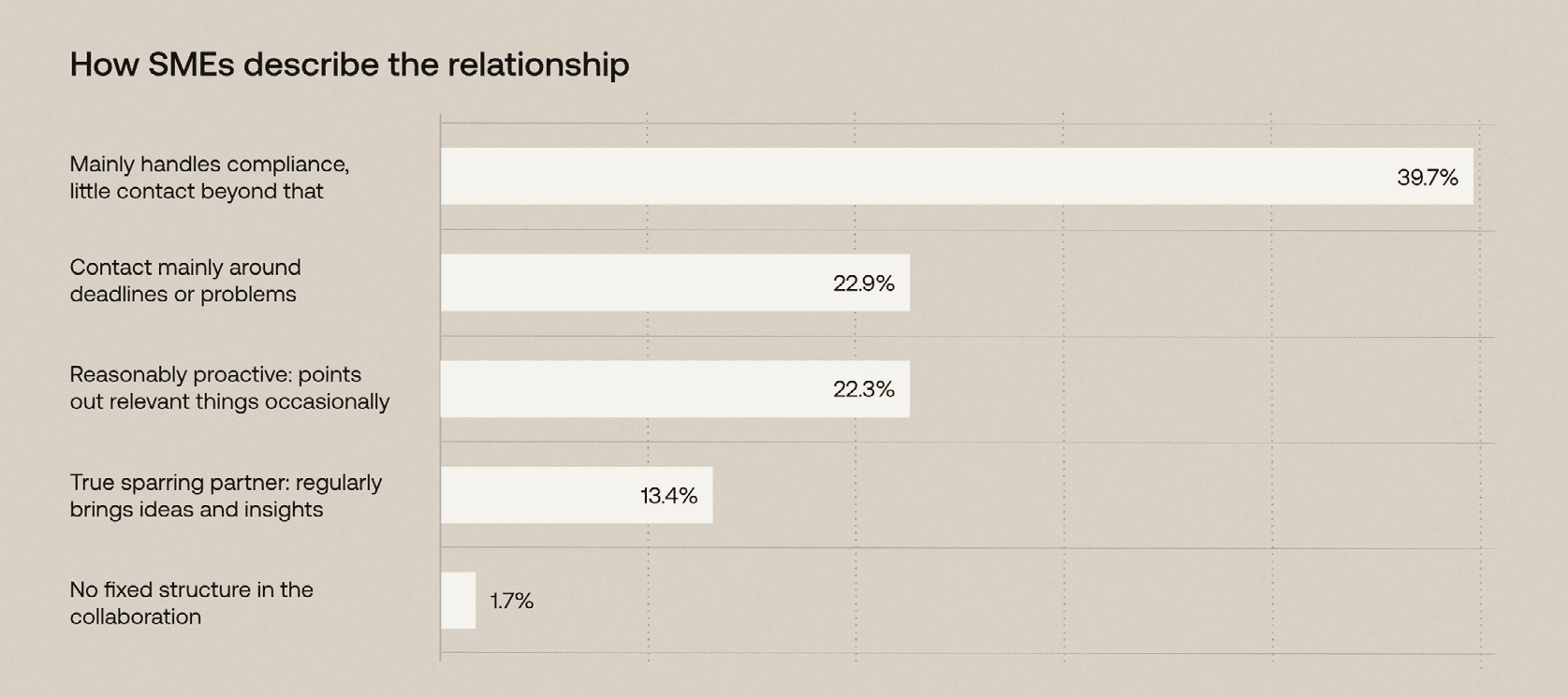
Most Dutch SMEs work closely with an external accountant or tax advisor. But "closely" is relative. Asked to describe the relationship, 39.7% said their accountant mainly handles compliance, with little contact beyond that. A further 22.9% said contact is primarily around deadlines or problems. Only 13.4% describe their accountant as a true sparring partner — someone who proactively brings ideas and insights on a regular basis.
Put together, nearly two-thirds of Dutch SMEs (64.2%) sit in a relationship that is primarily reactive and transactional.
On proactive contact, 47.5% of respondents say their accountant reaches out more than once a year with advice or insights, unprompted. But 40.2% report this happens only roughly once a year, and for 9.5% it's rarer still, or never.
The picture on business understanding is more reassuring: 86.6% say their accountant understands their business, including 31.3% who say thoroughly. Only 13.4% feel their accountant sees little beyond the financial figures. The gap isn't in understanding — it's in how often that understanding translates into proactive contact.
Chapter 2
The advice is missing where it matters most
Ask Dutch SMEs where they received no meaningful input from their accountant last year, and the list is striking. Business strategy tops the table: 35.8% said their accountant had no notable involvement in general business strategy or planning. More than three in ten had no input on staffing decisions with financial consequences (30.2%), tax planning beyond the annual filing (30.2%), or pricing and margin decisions (29.6%).
Only 11.7% said their accountant was involved in all major business decisions.
This isn't a picture of dissatisfaction. It's a gap between what the relationship currently delivers and what it could. When asked what single additional service they would most value from their accountant, two-thirds of Dutch SMEs (64.8%) named a service they don't currently receive. The responses cluster around a single theme: more engagement beyond the compliance cycle. The most common requests were regular check-ins on business performance and what the numbers actually mean (15.6%), clearer explanations of complex financial or tax matters (14.0%), and more proactive tax planning and financial advice throughout the year (10.6%).

Chapter 3
Something else is already filling the gap
When accountants aren't at the table, something else fills the space. For an increasing number of Dutch SMEs, that something is AI.
More than half of respondents (57.5%) say they use AI tools to get answers to financial or business questions, and 26.3% use them regularly — a clear sign of how quickly artificial intelligence in accounting-adjacent decisions is becoming normal for business owners, whether or not their accounting firm is part of that conversation. Of these AI users, 35.9% use AI specifically for tax planning or financial questions, nearly a third (33.0%) use it to prepare for financing or credit applications, and 29.1% for workforce and reorganisation decisions with financial implications.
Nearly one in five AI users (18.4%) uses AI to verify or cross-check advice received from their accountant. That figure is worth attention: for a significant share of AI-using SMEs, AI isn't supplementary to the accountant relationship — it's a quality check on it.
AI isn't the only alternative, either. Two in five respondents (39.7%) turn to their bank or a financing partner for financial or strategic guidance. Peer networks (22.9%), online sources (21.2%), and industry associations (21.2%) are also widely used. Only 17.9% say they rely solely on their accountant for this type of advice — the rest have built a patchwork of informal advisors, digital tools, and institutional relationships to fill the gap.

Chapter 4
Patience is not unlimited
Against the backdrop of a largely transactional relationship, the loyalty data deserves attention. More than six in ten Dutch SMEs (60.3%) have at some point thought about switching accountants in the past year. Of these, 38.5% did so seriously — actually switching, or seriously considering it.
This isn't a sign of mass dissatisfaction. But it could mean the status quo doesn't automatically hold — satisfaction scores may be masking a more fragile relationship than they appear to show. On whether compliance work could be replaced by software or AI, the industry itself is clear-eyed: 55.9% believe this is likely within the foreseeable future, including 15.1% who say it's already possible today.
Currently, 55.9% rate the value for money of their accountant's compliance work as "good" and 12.3% as "excellent" — reassuring headline numbers. But 18.4% call it merely acceptable, and 8.4% see it as poor value. If the perception of compliance as software-replaceable grows, that price pressure is likely to intensify.
Looking ahead, 43% of SMEs expect the relationship to stay broadly the same. But 19.6% see the accountant's role shrinking as AI and digital tools advance, and 8.4% expect to handle more financial tasks independently. Only 14.5% expect their accountant to become more important as a trusted advisor.
The market appetite for proactive advice, meanwhile, is substantial: a third of SMEs (33.5%) would pay the same fee but expect significantly more service. A further 37.4% would actively pay more — 27.9% up to 20% more, and 9.5% over 20% more. Combined, 70.9% expect greater value from the relationship, whether through a higher fee or more service at the existing price. Only 14.0% say they wouldn't pay more regardless of service level.

Conlusion
The window is narrowing
While this report may sound alarmist, accounting in the Netherlands is not facing an immediate crisis. Most Dutch SMEs feel reasonably understood, are broadly satisfied with the value of compliance services, and aren't cancelling their contracts tomorrow.
But this report identifies something more subtle and, over time, more consequential. The accountant's role is being quietly narrowed from the outside. AI tools are answering the questions that used to be kept for the annual meeting. Banks are filling the financial planning conversation. Peer networks are replacing the trusted advisor for strategic decisions. While four in ten SMEs have seriously considered switching accountants in the past year, the relationship is clearly less anchored than it may appear from the firm's side.
The firms with the most to gain are those that stop waiting to be asked. The 64.8% of SMEs who say they want more from their accountant aren't planning to switch today or tomorrow. But they are open to a different kind of relationship: one that is proactive, built around the business, rather than the usual compliance calendar.
The market appetite for advisory services is apparent: 70.9% of SMEs expect more value, either at the same price or for a premium. The clients have made their move. The firms that step out from behind the compliance calendar will set the standard for what comes next.
About Ravical
Ravical is an agentic AI platform — AI accounting software built for accounting and tax firms that deliver both compliance and advisory services. The industry is moving toward advisory as its primary growth engine, but most accounting firms are still running on infrastructure built for compliance — and that gap creates real pressure on the people doing the work.
Ravical's accounting workflow automation embeds AI agents directly into existing firm systems, monitoring client communications and financial data to surface advisory opportunities and prepare the groundwork before an adviser needs to act. Partners and managers stay in control throughout, with full visibility into what the agents are doing and why.
The result: advisory work moves faster, more opportunities get captured, and the work that requires human judgement gets the time and attention it deserves.
Half of UK accounting firms say the biggest barrier to advisory growth isn't time. It's that their teams are built for compliance, not advisory. New research from 500 senior decision-makers reveals why freeing up capacity won't fix a skills problem.